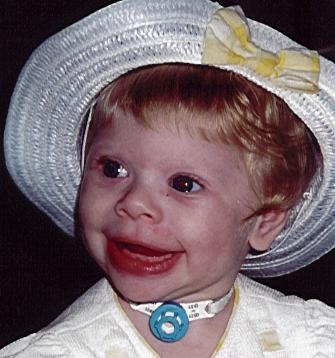
Rachel Brustein

After a normal pregnancy and delivery, Rachel Brustein was born on August 3, 1994 with esophageal atresia with proximal and distal tracheal esophageal fistulas (TEF), a right sided aortic arch, double aortic arch, and both ventricular and atrial septal defects. The TEF repair was performed the next day; the cardiac surgery was performed nine weeks later.

Rachel had severe problems with reflux and respiration after her initial surgery. The diagnosis was bilateral vocal fold paralysis with upper airway obstruction, tracheomalacia, bronchomalacia, microgastria and gastroesophageal reflux. She received her trach when she was six weeks old. Rachel is not likely to recover any function of her vocal cords. Her trach may be permanent.

A few days after her heart surgery, Rachel’s stomach ruptured. The cause has never been identified. She then suffered from acute peritonitis and sepsis. For the following month all of her nutrition came through a central line.

Due to the abnormally small size of her stomach and the severe reflux, Rachel could not tolerate any type of feeding through her gastronomy tube. A combination gastronomy-jejuenal tube was inserted (with great difficulty) to provide continuous drip feeding 21 hours per day via a Kangaroo pump.

This was the state of affairs when Rachel left the hospital for the first time, 5 months after birth. The need to simultaneously manage the near continuous drip feeding and the trach was exhausting. Rachel’s gastric secretions had to be collected and recycled on 4 hour cycles. There were frequent trips to the hospital to reinsert (via fluoroscopy) the feeding tube, which became even more prone to being dislodged as Rachel became older and more active.

Finally, when Rachel was a year old she began oral feeding on a trial basis. She loved it, and all tube feeding was discontinued 8 months later.

Now, Rachel is a happy 3 year old with a trach. She has been using a Passy-Muir speaking valve since she was 8 months old. Her speech and physical development have not been impaired.

We are amazed by the extent to which she can lead a normal kid's life. She went to day camp this past summer and is starting preschool this fall. She spends her free time hanging out at the park or indoor tot lot.

We are interested in hearing from parents of older children with a trach about their experiences with child rearing, socialization, medical management and surgical options. We will be happy to share our experiences.

Update - July 1999: For the past 2 years Rachel has been leading a normal lifestyle, engaging in all activities except swimming and water games. After 2 good years at preschool , she is starting kindergarten at a public school in the fall. However, her vocal cord paralysis is permanent .

In May, Dr. Lauren Hollinger performed a cordotomy, a procedure which he has recently begun advocating for management of bilateral vocal cord paralysis. As a result of the surgery, Rachel's voice is softer and raspier than it had been, but the articulation is not affected. On July 13, Rachel was decannulated, quite simply and easily. She appears to be doing fine. We know that she will not be able to engage in strenuous aerobic activity; her airway is adequate, but obstructed by the paralyzed vocal cords. So far she is doing everything she did before the decannulation. We don't know what her limitations will be. Right now, all of us are very happy.

October 2001

Update - November 2001:  Rachel is now in second grade and is totally mainstreamed.  She participates in ice skating, theater, dance and glee club.  Just recently she started pee wee tennis. Due to permanent bilateral vocal cord paralysis, she is hampered by limited respiratory function.  It is impossible for her to participate in aerobic activities such as soccer and she is just beginning to understand why she is always the last person to finish in running games.  Rachel's noisy breathing is the only overt clue that she had a tracheostomy for five years.

arrow3.gif (1307 bytes)


Send mail to Cynthia Bissell with questions or comments about this web site.
Copyright © 1996-2008 Aaron's Tracheostomy Page