
Tracheostomy Care
Rubbing of the trach tube and secretions can irritate the skin around the stoma. Daily care of the trach site is needed to prevent infection and skin breakdown under the tracheostomy tube and ties. Care should be done at least once a day; more often if needed. Children with new trachs or children on ventilators may need trach care more often. Tracheostomy dressings are used if there is drainage from the tracheostomy site or irritation from the tube rubbing on the skin.
It may be helpful to set up a designated spot in your home for equipment and routine tracheostomy care.
Equipment
- Sterile cotton tipped applicators (Q-tips)
- Trach gauze and “unfilled” gauze
- Sterile water
- Hydrogen peroxide (1/2 strength with sterile water)
- Trach ties and scissors (if ties are to be changed)
- Two sterile cups or clean disposable paper cups
- Small blanket or towel roll
Procedure
- Wash your hands.
- Explain procedure in a way appropriate for the child’s age and understanding.
- Lay your child in a comfortable position on his/her back with a small blanket or towel roll under his/her shoulders to extend the neck and allow easier visualization and trach care.
- Open Q-tips, trach gauze and regular gauze.
- Cut the trach ties to appropriate length (if trach ties are to be changed).
- Pour 1/2 strength hydrogen peroxide into one cup and sterile water into the other.
- Clean the skin around the trach tube with Q-tips soaked in 1/2 strength hydrogen peroxide. Using a rolling motion, work from the center outward using 4 swabs, one for each quarter around the stoma and under the flange of the tube. Do not allow any liquid to get into trach tube or stoma area under the tube.
Note: Some doctors recommend cleaning with just soap and water in home care, using hydrogen peroxide only to remove encrusted secretions. This is because
daily use of hydrogen peroxide might irritate the skin of some children. - Rinse the area with Q-tip soaked in sterile water.
- Pat dry with gauze pad or dry Q-tips.
- Change the trach ties if needed (See Changing a Tracheostomy Tube).
- Check the skin under the trach ties.
- Tuck pre-cut trach gauze around and under the trach tube flush to skin. Do not cut the gauze or use gauze containing cotton because the child may inhale small particles. Use precut tracheostomy gauze or unfilled gauze opened full length and folded into a U shape or use two gauze pads, one placed under each wing of the tube. Be sure the trach dressing does not fold over and cover the trach tube opening. Change the dressing when moist, to prevent skin irritation. Tracheostomy dressings may not be needed for older tracheostomies when the skin is in good condition and the stoma is completely healed and free from rash or redness.
- For tracheostomy tubes with cuffs, check with your doctor for specific cuff orders. Check cuff pressure every 4 hours (usual pressure 15 – 20 mm Hg). In general, the cuff pressure should be as low as possible while still maintaining an adequate seal for ventilation.
- Monitor skin for signs of infection. If the stoma area becomes red, swollen, inflamed, warm to touch or has a foul odor, call your doctor.
- Check with the doctor before applying any salves or ointments near the trach. If an antibiotic or antifungal ointment is ordered by the doctor, apply the ointment lightly with a cotton swab in the direction away from the trach stoma.
- Wash your hands after trach care.
Care of the Inner Cannula
Some older children and teens have trach tubes with an inner cannula. Some inner cannulas are disposable (DIC: Disposable Inner Cannula). These should be changed daily, discarding the old cannula. Check with your equipment vendor regarding disposable cannulas.
For the reusable cannulas, the cannula should be cleaned 1 to 3 times a day and more often if needed. Do not leave the inner cannula out for more than 15 minutes.
Equipment
- 1/2 strength hydrogen peroxide
- Sterile water or normal saline
- Two clean or sterile containers (small bowl or cup)
- Inner cannula brush (tracheostomy brush or sterile pipe cleaner)
- Unfilled gauze padCleaning kits are available for inner cannula trach care. Check with your supply vendor.
Procedure
- Wash your hands.
- Explain procedure in a way appropriate for the child’s age and understanding.
- Pour 1/2 strength hydrogen peroxide into a bowl or cup and normal saline or sterile water into the other.
- Open the gauze pad
- Remove the inner cannula
- Place the inner cannula into 1/2 strength hydrogen peroxide. Soak it for a few seconds and use the brush to clean secretions on the inside and outside of cannula.
- Place the cannula into normal saline or sterile water solution, soak and rinse.
- Dry off excess water with clean or sterile gauze pad.
- Suction through the outer cannula if needed.
- Replace inner cannula. Be sure the cannula is secure or “locked” in place in the trach tube.
- Wash your hands.
Cuffed Tracheostomy Tubes
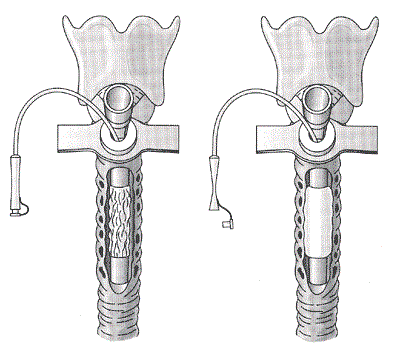
A cuff is a soft balloon around the distal end of the tube that can be inflated to seal the trachea for children needing ventilator support or to help prevent secretions from entering the lungs.
Avoid over inflating the tracheostomy tube cuff. The pressure of the cuff against the wall of the trachea can cause damage if it is too high. Two techniques that can be used to help avoid excess pressure are the minimal occluding volume technique and the minimal leak technique.
Suction the trach tube if needed. After suctioning the tube, suction the mouth and above the trach cuff so that secretions do not go into lungs when cuff is deflated.
Cuff Deflation Techniques
- Minimal Occluding Volume Technique: Deflate the cuff, then slowly begin re-injecting air (or sterile water depending on the type of tube) with a luer lock syringe. Place a stethoscope to the side of the child’s neck near the trach tube. Inject air into the pilot line until you can no longer hear air going past the cuff. This means the airway is sealed. For children that are totally ventilation dependent, provide breaths with manual resuscitator.
- Minimal Leak Technique: The same procedure as Minimal Occluding Volume, except that after the airway is sealed, slowly withdraw a small amount (approximately 1cc), so that a slight leak is heard at the end of inspiration.
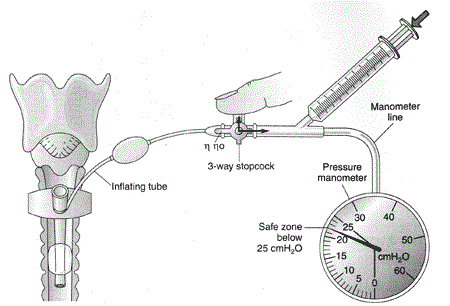
Periodic measurements of the cuff volume should be noted and any changes reported to the doctor. A pressure manometer may be used to check cuff pressure on balloons filled with air. Generally, cuff pressure should be below 25 cm H2O.
 Aaron's Tracheostomy Page